SpaceX and the Future of the Moon
- Jun 15
- 3 min read
On Friday, 6/12 SpaceX went public with the largest IPO in history, an almost laughable $1.77 trillion. Some estimates suggest that means Elon Musk might also become the world's first trillionaire, which . . . yikes.
The jump from billionaire to trillionaire is so massive that it's truly beyond human comprehension. To put it into perspective, if $1 = 1 second, then a millionaire is 11 days. A billionaire is 31 years.
A trillionaire is 31,000 years.
They're just nowhere near each other. It's such a large concentration of money in the hands of a single man, that it should be a cause of concern for anyone.
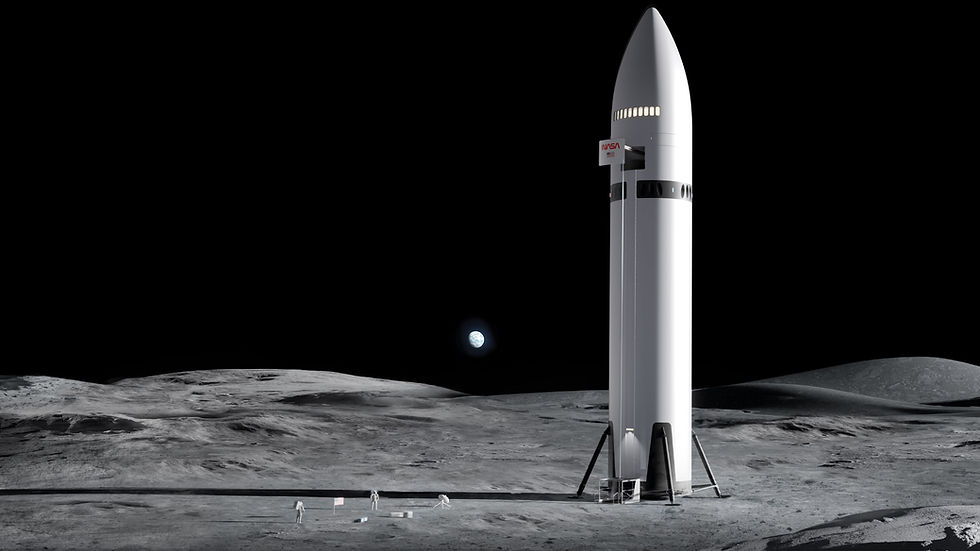
SpaceX held out for a while, but they finally decided to "go public" for the same reason that most companies do: money. SpaceX has had issues with their Starship rocket, from test failures to setbacks, and that's a problem because a lot hinges on Starship. It's supposed to be the primary mode of transportation for not only for NASA's Artemis astronauts to land on the Moon, but also for the fleet of orbital data centers that major tech, space, and military organizations want to launch into space.
Starship has had a lot of problems. This could be a way for SpaceX to raise more funds to perfect what is looking like their single point of failure.
"Going public" is a way for companies to raise additional funds to pay off debts, expand, or to raise their public image. Most will go public on a Tuesday, Wednesday or Thursday to take advantage of the momentum during the week. But SpaceX did something different; they chose Friday.
Friday is an interesting choice because the markets are closed on Saturday and Sunday, meaning that trades can't occur again until the market opens back up on Monday.
The decision for Friday makes sense, SpaceX is the largest IPO in history, and that could cause a lot of volatility. Pushing it to the end of the week gives everyone the weekend to "cool off."
The first question you might be asking after, "what does someone do with a trillion dollars?" is probably, "why does everyone want to go to the Moon anyway?"
To be frank, there is very little, if any immediate monetary value to the Moon. If the day ever comes that mining Helium-3, or ice, or some other resource is occurring on the regular, then yes, money will probably be made. But right now, it's simply a race. Don't get me wrong, it's an investment as well, and I love the technological breakthroughs and human curiosity that come with space expansion, but let's not kid ourselves, every space-capable nation and company wants to be the first to snag their slice of the pie.
Because that's what the Moon is: real estate.

It's not an open conversation, but it is one happening behind the scenes. The Moon is the first, real, attainable slab of land that humanity has had in a very long time. This isn't a small nation or island, it's an entire celestial body. And there's really nothing to stop anyone from breaking ground.
The Outer Space Treaty of 1967 is the only real international space law that we have, and it's a super broad one. While a nation can't claim sovereignty and set up border patrol, it's not clear about selling condos, and even if it was, who would stop them?
Pretty much every war on Earth can be traced to a land grab of some kind. Land holds minerals, water, trees, and all sorts of resources that we've been fighting over since the beginning of time. The Moon's resources (beyond land) are finite and tricky, requiring major breakthroughs in technology before becoming feasible.
Acquiring the land is simply the first step.
Think of it this way, if a nation lands in one crater, it may not be official, but the general consensus will be, "oh hey, that's their crater. Let's go find our own." There will be plenty to go around at first, but one day there may not be. Or one crater proves to be exceptionally valuable. Who knows. But rules need to be in place to prevent a conflict before ambiguity breeds one.
The point I'm trying to make is that the world has its first trillionaire, and there are no substantial international laws to rein in an entire industry's celestial access.


